Quantum development has a workflow problem. The hardware limitations get all the attention, but most teams slow down long before they reach a QPU. They are switching between SDKs, managing simulator environments, checking provider dashboards, reading error logs in three different formats, and rebuilding context every time they move between tools. The fragmentation is not theoretical. It shows up in every team working seriously on quantum software today.
The hardware is noisy, limited, and expensive to access. That part is well understood. What is less talked about is that even reaching the hardware requires navigating a stack that was never designed to work together. Qiskit for circuit construction, a different tool for compilation, a cloud dashboard for queue management, something else for result analysis. Each transition costs time and introduces points of failure.
The Fragmented Stack
A quantum developer working on a real problem touches a lot of systems before a job runs. There is the SDK layer, where circuits are defined and optimized. There is the simulator layer, where most testing happens because real hardware time is scarce. There is the backend selection problem, because different hardware types handle different workloads differently. There is the submission layer, the monitoring layer, and the analysis layer. None of these were built to share a common interface.
This is not a failure of any individual tool. Qiskit is well built. PennyLane handles hybrid workflows cleanly. D-Wave Ocean has a clear model for annealing problems. The issue is that nothing coordinates them. A developer working across multiple frameworks, multiple providers, and multiple problem types is doing a lot of work that has nothing to do with quantum computing.
What QSHA256 Is Building
QSHA256 is building the control plane for quantum workflows. Not a new SDK. Not another simulator. The layer that sits between the developer, the software stack, and the quantum machine. The goal is to let a developer define a problem, get AI assistance on framework selection and workflow structure, test on a simulator, optimize, and then route to hardware without switching contexts or rebuilding their setup.
The platform connects across quantum software frameworks, provider APIs, simulators, cloud platforms, and classical tooling through a single secure environment. It does not own quantum hardware. It orchestrates access to it through software and secure automation.
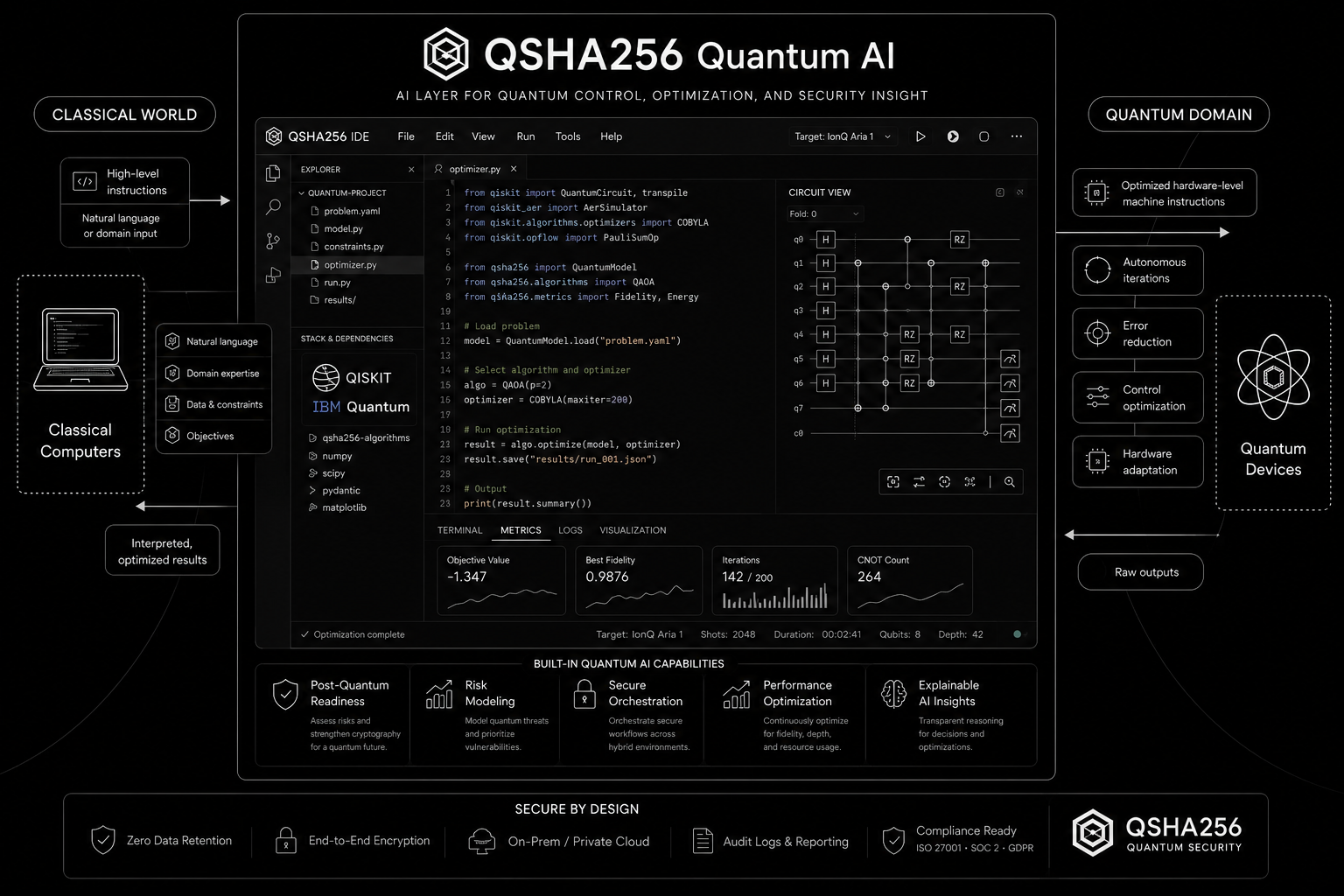
The QSHA256 IDE
The IDE is where the workflow lives. A developer can work with quantum code, circuit views, simulator results, backend status, execution logs, and security reports in one place. The design principle is that a quantum developer should not need to leave their environment to understand what is happening at any point in the pipeline.
Circuit visualization is embedded so changes are immediately visible. Execution metrics sit next to the code rather than in a separate dashboard. Backend status is live. Logs are structured and searchable. Security reports are part of the workflow rather than an afterthought attached at the end.
Most quantum work should begin on simulators before it touches real hardware. The IDE makes that default easy. Local simulation, GPU-accelerated simulation, and cloud simulation are all accessible from the same interface, and the path from simulation to hardware submission does not require a context switch.
AI-Assisted Quantum Development
AI in QSHA256 is not a chatbot layered on top of the workflow. It is integrated into the problem-to-workflow translation layer. A developer describes a problem at a high level. The AI helps structure it into a quantum-ready workflow, suggests relevant frameworks, generates baseline circuit code, sets up the simulation environment, and flags potential issues before anything reaches hardware.
It does not replace the quantum developer. It gives the developer a faster control surface over a complex stack. Algorithm selection, code scaffolding, framework suggestions, simulation setup, result interpretation, documentation. Tasks that are slow not because they require deep expertise but because the tooling is scattered.
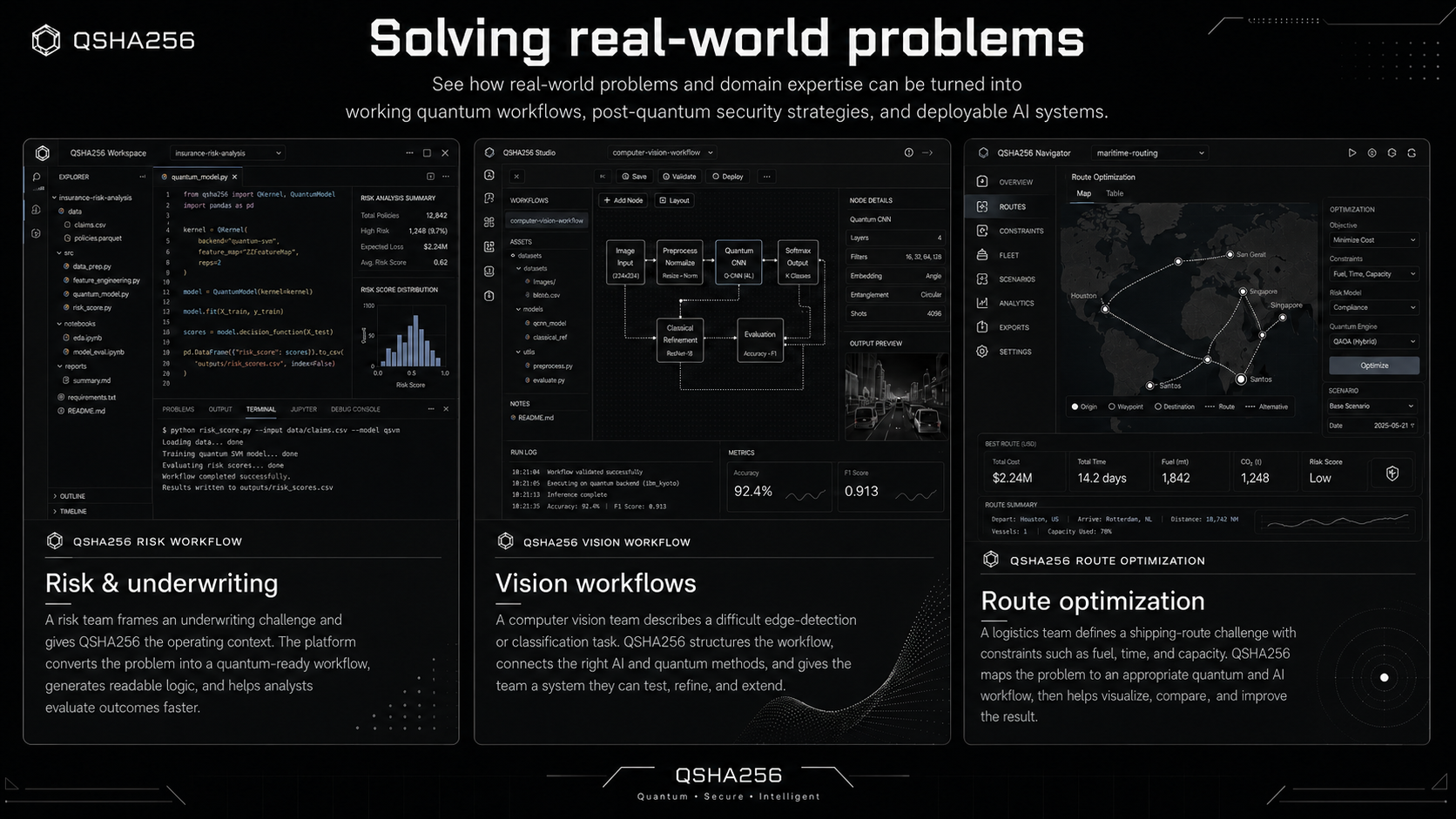
The real-world examples above show the pattern. A reinsurance specialist describes a risk problem. A computer vision team wants quantum-inspired edge detection. A logistics developer needs route optimization at scale. In each case, the workflow starts from a domain description, not from a circuit. QSHA256 maps from the problem down to the framework, the simulator, and the backend. The domain expert does not need to understand QPU gate depth to get started.
Framework Agnostic by Design
QSHA256 does not bet on a single framework. The quantum software ecosystem is not going to consolidate around one SDK, and any platform that assumes it will is building on a fragile foundation. The stack is designed to work across the ecosystem.
Classical tooling is not secondary. Data preparation, result analysis, API integration, and deployment automation all happen in Python and run alongside the quantum components. The boundary between classical and quantum is a technical detail of the execution, not a wall in the development environment.
Provider Agnostic Hardware Access
Different quantum hardware types are suited to different problem classes. Superconducting gate-based systems handle general circuit workloads. Trapped-ion systems offer longer coherence times at lower qubit counts. Neutral atom platforms are showing strong scaling trajectories. Annealing systems excel at specific combinatorial optimization problems. Hybrid solvers combine classical and quantum compute. QSHA256 is not locked into one of these.
The selection of which backend to use is not a manual decision the developer makes by reading provider documentation. The workflow layer recommends based on problem type, qubit requirements, current queue depth, cost, and the workload's noise tolerance. The developer approves the target and submits. The platform handles the submission interface.
Security Built Into the Workflow
Quantum orchestration is not about hiding complexity. It is about putting complexity under control. Security is part of that. As quantum workflows mature, the questions that security teams will ask are not theoretical: Where did this job run? Who submitted it? What data was sent to which provider? How are results stored? Is this workflow compliant with our data policy?
QSHA256 builds for these questions from the start rather than adding a security report at the end.
Data protection is particularly important for quantum workloads because the jobs often encode proprietary problem structures. The input to a quantum optimization run can reveal as much about a business as the output. That data needs to be handled with the same care as any other sensitive compute workload.
A Concrete Workflow
The abstract version of what the platform does is easier to understand when it is mapped to a specific sequence. Every workflow through QSHA256 follows a version of this path:
The developer controls every step. The platform removes the friction between them.
Why Build This Now
Current quantum hardware is still early. Gate error rates are improving but remain a constraint on circuit depth. Qubit counts are growing but fault-tolerant scale is still years out. None of that changes what needs to be built at the software layer.
The companies that build orchestration capability now will have a real advantage when hardware improves. The workflow patterns, the security models, the framework integrations, and the team practices that emerge from working seriously with today's hardware are not wasted work. They are the foundation for what comes next.
The quantum industry is not only a hardware race. It is a software race and an integration race. The teams that understand how to move a problem from description to execution across a heterogeneous stack are the teams that will be ready.
The future of quantum computing will not be shaped only by who owns the hardware. It will also be shaped by who can orchestrate the full workflow around it: the problem, the code, the simulator, the backend, the hardware, the result, and the security layer. That is the role QSHA256 is building for.